
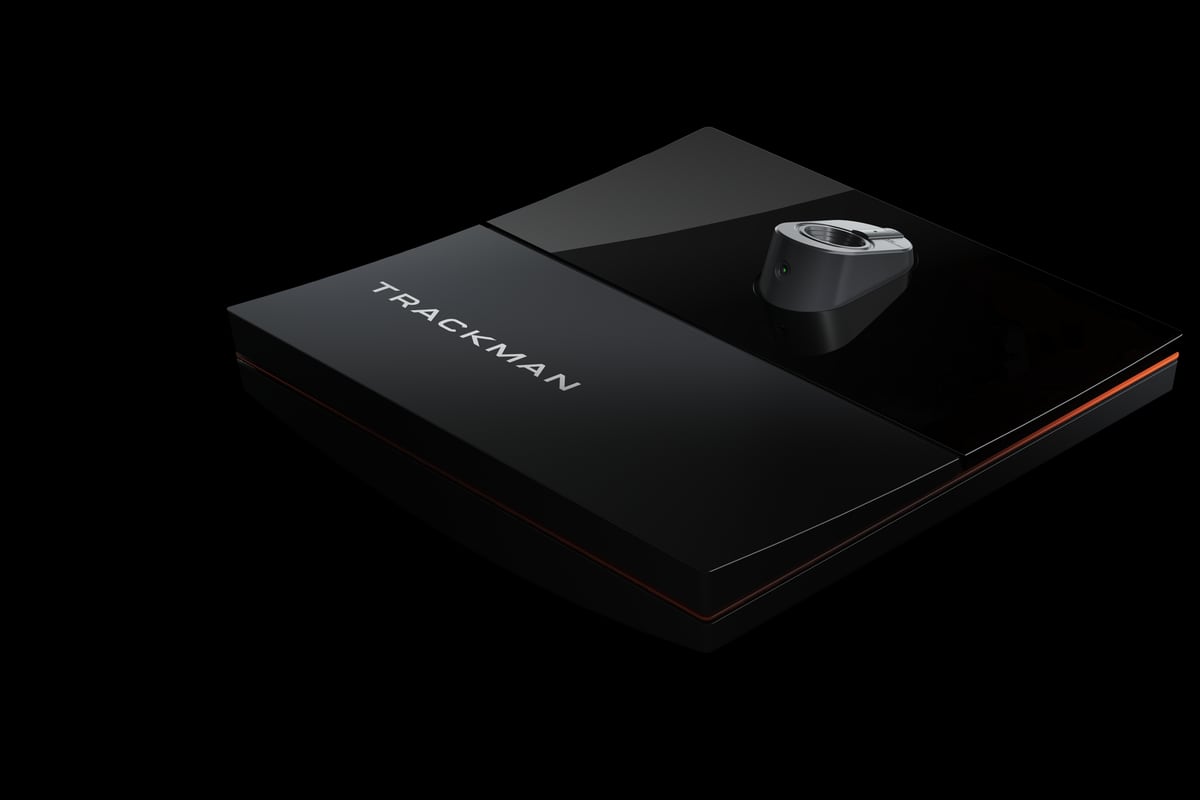
TrackMan tells you the truth about your golf swing in numbers — how fast you swing, how fast the ball leaves, how high and how far it flies, how much it spins, and how cleanly you struck it. Instead of guessing why a shot felt off, you get measured data on every swing, so you can practice with facts instead of feelings.
That’s the whole reason a serious launch monitor beats a foggy driving range. The range gives you a vague sense of “that one looked okay.” TrackMan gives you the exact club speed, the precise launch angle, and the carry distance down to the yard. At Swing Spot in Clovis, every bay runs commercial TrackMan, so you see this on each shot. Here’s what the most important numbers actually mean — in plain English, no engineering degree required.
Why the numbers matter at all
Most amateurs improve slowly because their feedback is bad. You hit a shot, it goes somewhere, and you draw a conclusion that may be completely wrong. “I need more power” when the real issue is a glancing strike. “My driver is broken” when the real issue is too much spin.
Data fixes that. When you can see which number is off, you stop treating symptoms and start treating causes. You also stop wasting practice time grinding on things that were never the problem. A few honest metrics will teach you more in an hour than a season of guessing on the range.
You don’t need to memorize all forty-plus data points TrackMan captures. Six numbers carry most of the meaning for most golfers. Master these and you’ll understand your own swing better than the vast majority of players ever do.
Club speed
What it is: How fast the clubhead is moving at impact, measured in miles per hour.
Club speed is your raw engine. It’s the single biggest factor in how far you can hit the ball, because faster club speed creates the potential for faster ball speed and more distance. A driver swung at 85 mph and one swung at 105 mph live in completely different distance worlds.
How to use it: Club speed is your distance ceiling. If you’re chasing more yards, this is the number to grow over time through better mechanics and, eventually, speed training. But here’s the catch most people miss: raw speed is wasted if you don’t strike the ball cleanly. Plenty of golfers swing fast and lose half that potential to a poor strike. Which is exactly why the next numbers matter.
Ball speed
What it is: How fast the ball is traveling the instant it leaves the clubface, in miles per hour.
If club speed is the engine, ball speed is the actual horsepower that reaches the road. It’s the truest predictor of distance there is, because it reflects not just how hard you swung but how efficiently that energy transferred into the ball. Two players with identical club speed can have very different ball speeds — and the one with the higher number hits it noticeably farther.
How to use it: Ball speed is the headline distance number to chase, and it’s the bridge to the most useful metric of all, which is coming up next.
Smash factor
What it is: Ball speed divided by club speed. It’s a single number — usually somewhere around 1.3 to 1.5 with a driver — that measures strike quality.
Smash factor is the efficiency score, and it’s the metric that quietly humbles people. A high smash factor means you found the center of the face and transferred your speed beautifully. A low one means you’re leaking energy off the heel, the toe, or a thin strike, no matter how hard you swung.
How to use it: This is the most actionable number for the average golfer. Chasing more distance? Don’t start by swinging harder — start by raising your smash factor. Center-face contact is free yards. A driver near 1.5 is striking it pure; well below that, and you’re giving distance away on every swing. Watch this number climb as your strike improves and you’ll feel the progress immediately.
Launch angle
What it is: The vertical angle, in degrees, at which the ball leaves the clubface relative to the ground.
Launch angle is the start of the ball’s story in the air. Too low and the ball never gets up to ride; too high and it balloons and stalls. The ideal launch depends heavily on the club — a wedge launches high by design, a driver wants a more moderate, optimized launch to maximize carry.
How to use it: Launch angle works hand in hand with spin to determine your shot’s shape and distance. If your driver shots fly low and fall fast, or balloon up and drop short, your launch is likely off — often fixable through tee height, ball position, or attack angle. Seeing the number lets you experiment and watch the result change in real time.
Spin rate
What it is: How fast the ball is spinning backward (backspin) after impact, measured in revolutions per minute.
Spin is the most misunderstood number in golf, and one of the most important. The right amount of backspin keeps the ball airborne and stable. Too much, and your driver climbs, stalls, and dumps distance — that high, weak fade that comes up short. Too little, and shots can knuckle and fall out of the sky unpredictably. Each club has its own healthy spin window: drivers want less, wedges want plenty so the ball checks up on the green.
How to use it: If you hit your driver pure but it still comes up short, excess spin is a prime suspect — and it’s nearly impossible to diagnose without a launch monitor. This is exactly the kind of hidden problem TrackMan exposes. Once you can see it, you can fix it with equipment, ball position, or strike adjustments.
Carry distance
What it is: How far the ball travels through the air before its first bounce, in yards. (Total distance adds the roll; carry is the part you actually control.)
Carry is the number that matters for scoring, because it tells you how far each club actually flies for you — not the inflated number from your best-ever swing or the figure on the club’s marketing. Knowing your real carry distances is the difference between a confident approach shot and a guess.
How to use it: Build a personal yardage chart from your real carry numbers. When you know your 7-iron carries a true, repeatable distance, club selection on the course stops being a gamble. This single habit — knowing your carries — quietly drops more strokes than almost anything else, and a TrackMan session is the fastest way to gather them honestly.
How the numbers fit together
No metric lives alone. Distance is a chain: club speed creates potential, smash factor decides how much of it reaches the ball, ball speed reflects the result, and launch plus spin shape how that speed turns into carry. A weak link anywhere costs you yards.
That’s why reading them together beats obsessing over any one. The golfer who swings hard but strikes poorly fixes their smash factor first. The one with plenty of ball speed but short carry hunts down their spin. TrackMan lets you see the whole chain on every swing and find the link that’s actually holding you back.
The best part is the feedback loop. In a private bay at Swing Spot, you hit, you read the numbers, you adjust, and you hit again — dozens of measured reps in an hour, indoors, in any weather. That’s a faster path to real improvement than a season of guessing. See how the whole session flows on our how it works page, or step into the tech yourself in one of the private bays.
TrackMan Data FAQ
What does TrackMan measure? TrackMan measures over forty data points per swing, including club speed, ball speed, smash factor, launch angle, spin rate, and carry distance. For most golfers, those six numbers explain nearly everything about a shot.
How accurate is a TrackMan golf simulator? TrackMan is tour-proven and used on the PGA Tour and by professional club fitters. Its radar-plus-camera tracking makes the on-screen ball flight match real-course results closely, which is why the data is trusted for serious practice.
What is a good smash factor? With a driver, a smash factor near 1.5 indicates an excellent, center-face strike. Numbers well below that mean you’re losing energy and distance to off-center contact — making smash factor one of the most useful things to improve.
Why does my driver go short even when I swing hard? Often it’s too much spin or a poor strike, not a lack of speed. Excess backspin makes the ball balloon and stall, costing carry. TrackMan exposes both issues so you can address the real cause.
Can beginners benefit from TrackMan data? Yes. Clear, instant feedback helps new golfers learn faster than vague range sessions. You don’t need to understand every number to improve — even watching smash factor and carry climb builds better swings.
Where can I use TrackMan near Clovis, NM? Swing Spot in Clovis, NM runs commercial TrackMan in every private bay, available 24/7 to members. Book a session on the bays page and read your real numbers.
See your real numbers
Stop guessing what your swing is doing and start measuring it. Club speed, smash factor, spin, carry — the truth is in the data, and an hour with TrackMan will tell you more than a season of feel.
Step into a private bay at Swing Spot in Clovis and reserve your TrackMan session. Real golf, real data, open whenever you are.
Ready to see your numbers?
Two private TrackMan bays in Clovis, NM. Open 24/7 for members. Book by the hour — no membership required.